
The Beginning of the End of Star Formation

Time is running out for the galaxy NGC 3801, seen in this composite image combining light from across the spectrum, ranging from ultraviolet to radio. NASA's Galaxy Evolution Explorer and other instruments have helped catch the galaxy NGC 3801 in the act of destroying its cold, gaseous fuel for new stars. Astronomers believe this marks the beginning of its transition from a vigorous spiral galaxy to a quiescent elliptical galaxy whose star-forming days are long past.
Visible light from the Sloan Digital Sky Survey is seen in yellow shining from all of the galaxy's stars. Notice that NGC 3801 is starting to possess a broadly elliptical shape, the characteristic shape a galaxy assumes after forming from a merger of spiral galaxies. Some star formation is still taking place in NGC 3801, as shown in the ultraviolet by the Galaxy Evolution Explorer (colored blue), and in the dusty disk revealed in infrared light by NASA's Spitzer Space Telescope (red).
According to theory, that lingering star formation will soon be quenched by shock waves from two powerful jets shooting out of NGC 3801's central giant black hole. Radio emissions from those jets appear in this image in green. Like a cosmic leaf blower, the jets' expanding shock waves will blast away the remaining cool star-making gas in NGC 3801. The galaxy will become "red and dead," as astronomers say, full of old, red stars and lacking in any new stellar younglings.
Near-ultraviolet light from the Galaxy Evolution explorer at a wavelength of 230 nanometers is rendered in blue, while visible light at 469 nanometers from Sloan is displayed in yellow. Infrared light at 8 microns from Spitzer is red, and radio emission at 20 centimeters from NRAO's Very Large Array is overlaid in green.
Timeline of the Rise and Fall of NGC 3801
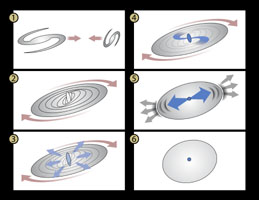
Diagram Credit: NASA/JPL-Caltech
Click on the image for larger view
Astronomers believe they have caught the galaxy NGC 3810 at a critical point in its history, just as it is making the transition from a vigorous spiral galaxy to a quiescent elliptical galaxy whose star-forming days are long past. This diagram sketches out the stages leading up to its current observed state and beyond.(1) Astronomers think the galaxy NGC 3801 formed around a billion years ago when two young, star-making spiral galaxies, perpendicular to one another, collided.(2) The remnant of this merger possessed a central core rotating in a "north-south" direction compared to the "east-west" direction of the surrounding disk. (3) The mashing together of gas and dust during the collision and merger unleashed a burst of star formation around 300 million years ago. The shortest-lived, biggest stars blew up in a few million years as supernovae. Winds and shocks from these explosions dissipated some of the cold gas in the galaxy needed to form new stars. Star formation began to decline in NGC 3801 accordingly. (4) Around five million years ago, the supermassive black hole at NGC 3801's core started to flare up, sending out jets of fast-moving particles from the surrounding material. Today we see the twin jets bent into an "S" shape from the rotation of the galactic disk. More powerful jets from the black hole appear to have started up in the past one or two million years but have not yet emerged from the galaxy's core.(5) In the next few million years, the stronger jets will send out shock waves into the disk of NGC 3801. The remaining gas and dust will be swept up and pushed out of the galaxy. (6) In about 10 million years or so, the expanding shock waves will have cleared out the remaining cold gas in NGC 3801 and star formation will cease. NGC 3801 will have transformed into an elliptical "red and dead" galaxy, full of old, red stars.