

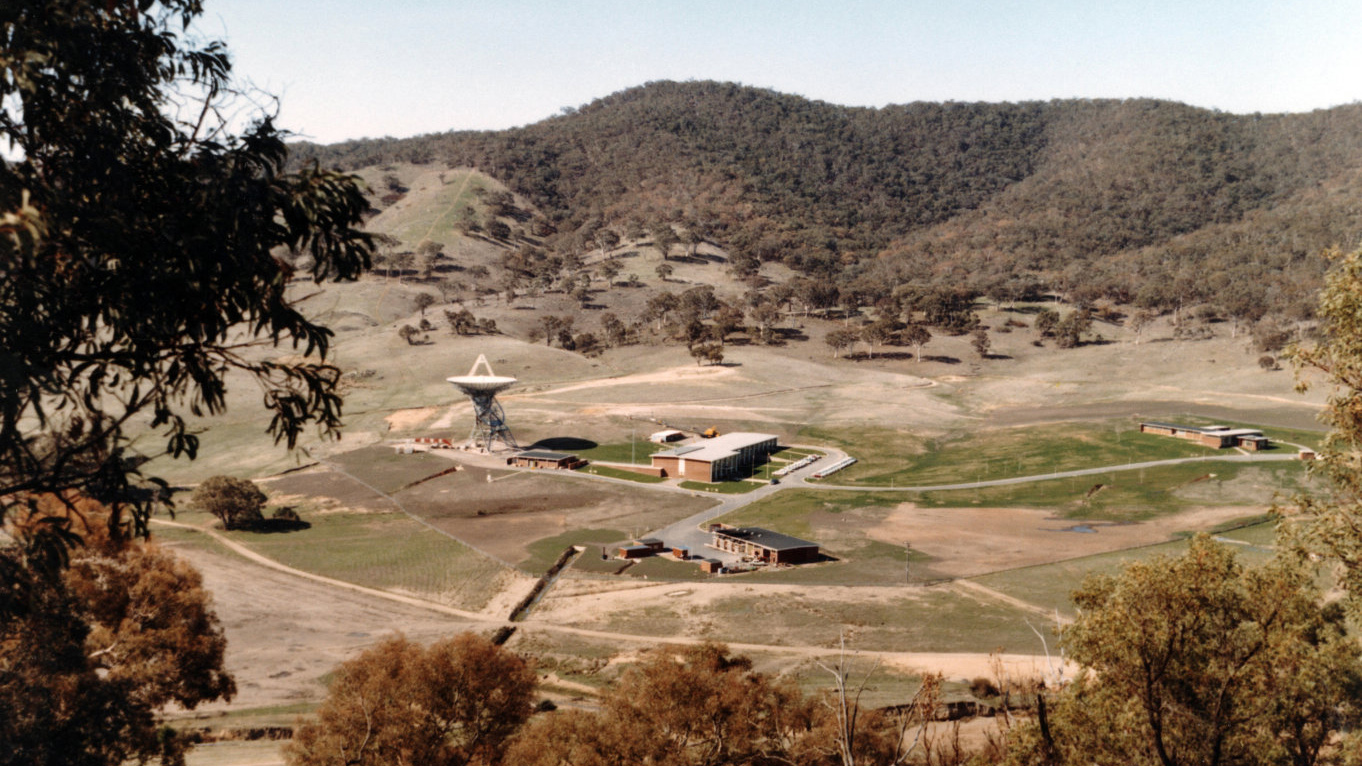
NASA’s Deep Space Network facility in Canberra, Australia celebrated its 60th anniversary on March 19 while also breaking ground on a new radio antenna. The pair of achievements are major milestones for the network, which communicates with spacecraft all over the solar system using giant dish antennas located at three complexes around the globe.
Canberra’s newest addition, Deep Space Station 33, will be a 112-foot-wide (34-meter-wide) multifrequency beam-waveguide antenna. Buried mostly below ground, a massive concrete pedestal will house cutting-edge electronics and receivers in a climate-controlled room and provide a sturdy base for the reflector dish, which will rotate during operations on a steel platform called an alidade.

Suzanne Dodd, the director for the Interplanetary Network Directorate at JPL, addresses an audience at the Deep Space Network’s Canberra complex on March 19, 2025. That day marked 60 years since the Australian facility joined the network.
“As we look back on 60 years of incredible accomplishments at Canberra, the groundbreaking of a new antenna is a symbol for the next 60 years of scientific discovery,” said Kevin Coggins, deputy associate administrator of NASA’s SCaN (Space Communications and Navigation) Program at NASA Headquarters in Washington. “Building cutting-edge antennas is also a symbol of how the Deep Space Network embraces new technologies to enable the exploration of a growing fleet of space missions.”
When it goes online in 2029, the new Canberra dish will be the last of six parabolic dishes constructed under NASA’s Deep Space Network Aperture Enhancement Program, which is helping to support current and future spacecraft and the increased volume of data they provide. The network’s Madrid facility christened a new dish in 2022, and the Goldstone, California, facility is putting the finishing touches on a new antenna.
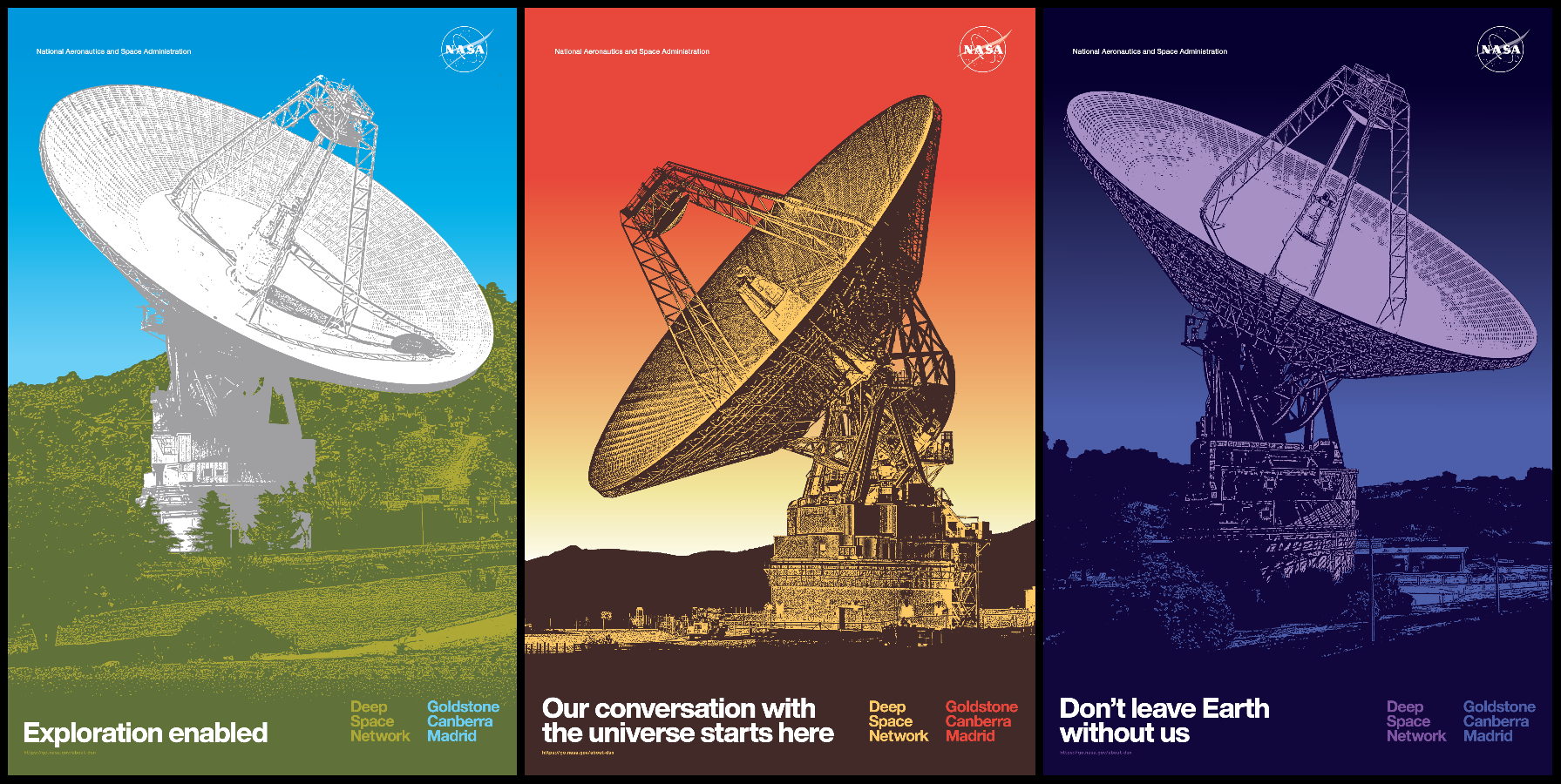
Three eye-catching posters featuring the larger 230-foot (70-meter) antennas located at the three Deep Space Network complexes around the world.
Canberra’s Role
The Deep Space Network was officially founded on Dec. 24, 1963, when NASA’s early ground stations, including Goldstone, were connected to the new network control center at the agency’s Jet Propulsion Laboratory in Southern California. Called the Space Flight Operations Facility, that building remains the center through which data from the three global complexes flows.
The Madrid facility joined in 1964, and Canberra went online in 1965, going on to help support hundreds of missions, including the Apollo Moon landings.
“Canberra has played a crucial part in tracking, communicating, and collecting data from some of the most momentous missions in space history,” said Kevin Ferguson, director of the Canberra Deep Space Communication Complex. “As the network continues to advance and grow, Canberra will continue to play a key role in supporting humanity’s exploration of the cosmos.”
By being spaced equidistant from one another around the globe, the complexes can provide continual coverage of spacecraft, no matter where they are in the solar system as Earth rotates. There is an exception, however: Due to Canberra’s location in the Southern Hemisphere, it is the only one that can send commands to, and receive data from, Voyager 2 as it heads south almost 13 billion miles (21 billion kilometers) through interstellar space. More than 15 billion miles (24 billion kilometers) away, Voyager 1 sends its data down to the Madrid and Goldstone complexes, but it, too, can only receive commands via Canberra.
New Technologies
In addition to constructing more antennas like Canberra’s Deep Space Station 33, NASA is looking to the future by also experimenting with laser, or optical, communications to enable significantly more data to flow to and from Earth. The Deep Space Network currently relies on radio frequencies to communicate, but laser operates at a higher frequency, allowing more data to be transmitted.
As part of that effort, NASA is flying the laser-based Deep Space Optical Communications experiment with the agency’s Psyche mission. Since the October 2023 launch, it has demonstrated high data rates over record-breaking distances and downlinked ultra-high definition streaming video from deep space.
“These new technologies have the potential to boost the science and exploration returns of missions traveling throughout the solar system,” said Amy Smith, deputy project manager for the Deep Space Network at JPL, which manages the network. “Laser and radio communications could even be combined to build hybrid antennas, or dishes that can communicate using both radio and optical frequencies at the same time. That could be a game changer for NASA.”
For more information about the Deep Space Network, visit: